

Description
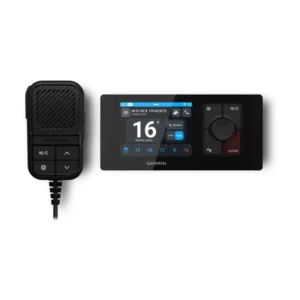
The GARMIN Signal RM 100 is a fixed-mount remote station for compatible Signal VHF 400 and VHF 220 radios. It extends VHF, DSC, AIS and intercom control to a second helm or flybridge with the same modern 3.5-inch touchscreen interface and fist-microphone format.
Main Features
- Remote control for compatible Signal VHF 400 and VHF 220 radios
- 3.5-inch color touchscreen with edge-to-edge glass
- Control of VHF, DSC, AIS and supported radio functions
- Included fist microphone with adaptive noise cancellation
- Garmin BlueNet networking for secondary-station installation
Second-station control
The RM 100 is intended for vessels with more than one operating station. It lets the operator access compatible Signal radio functions from a flybridge, tower or secondary helm without installing a second independent VHF system.
Network connection
The station connects through the Garmin BlueNet network to the primary Signal radio. This keeps controls integrated with the vessel’s Garmin electronics architecture.
Audio and intercom
The supplied fist microphone includes audio and noise-control features designed for use around wind and engine noise. Supported intercom functions can be used between compatible stations.
Installation planning
Plan BlueNet cable routing, station power and microphone placement before cutting the helm. The remote is not a stand-alone VHF transmitter; it requires a compatible Signal VHF radio on the network.
Audio management in a noisy cockpit
The Signal generation is designed around intelligible communications in wind, engine and wave noise. Adaptive background-noise cancellation works with the supplied microphone, while automated squelch reduces the need for constant manual adjustment. Garmin also supports recent-transmission playback, allowing an operator to replay traffic that was missed. Advanced watch modes can monitor multiple channels for activity.
DSC, MMSI and emergency readiness
Digital Selective Calling becomes useful only when the radio is correctly programmed with the vessel’s MMSI and has valid position information. The distress function can then transmit digital identity and position data to support emergency response. MMSI programming and licensing/registration requirements vary by country, so Canadian operators should follow ISED/Radio Amateurs of Canada and applicable maritime requirements.
Networked radio control
Signal radios can exchange supported AIS, DSC, GPS and heading information over NMEA 2000 and integrate with compatible Garmin chartplotters. Garmin marine networking supports the RM 100 secondary station, and Wi-Fi/ActiveCaptain is used for supported setup and software functions. This makes the series well suited to boats with a main helm plus flybridge or secondary control station.
Antenna and installation quality
A premium VHF can only perform as well as its antenna system. Antenna height, coaxial-cable loss, connector quality and grounding/installation practices affect range. The Signal VHF 400 is designed to handle VHF and its built-in AIS transceiver through the intended antenna arrangement; the VHF 220 receives AIS but does not transmit the vessel’s AIS position.
What’s in the Box
Signal RM 100 remote station, fist microphone, 6 m BlueNet cable, power/audio cables, mounting hardware and documentation.
Specifications
- Display: 3.5-inch color touchscreen, 640 × 480
- Head unit size: Approximately 75 × 160 × 29 mm
- Head unit weight: Approximately 240 g
- Fist mic: Approximately 100 × 60 × 31 mm; 245 g
- Input voltage: 9.6–32 VDC
- Networking: Garmin BlueNet
- Compatibility: Signal VHF 400 and VHF 220
- Water rating: IPX7 class marine protection




Reviews
There are no reviews yet.