
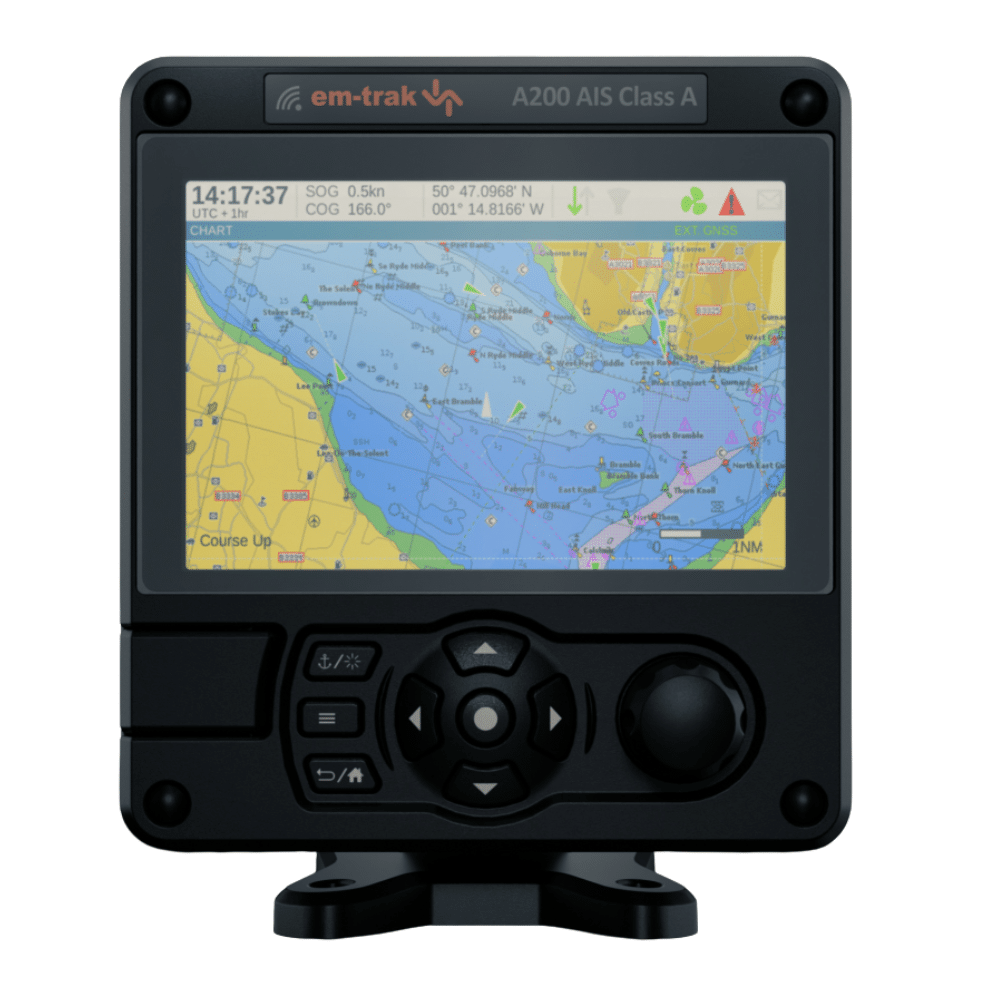
A SOLAS-certified Class A AIS transceiver engineered for commercial vessels, providing continuous high-priority AIS transmission, voyage data management, and deep integration into professional bridge systems for traffic control, compliance, and collision avoidance.
CAD $3,004.99
Ships/Pickup in 1–2 Days
The EM-TRAK A200 is a fully compliant, professional Class A AIS transceiver designed for vessels operating under SOLAS and inland waterway regulations. Unlike Class B AIS units, which are primarily situational awareness tools, the A200 functions as a mandatory safety and traffic-management system, transmitting high-priority AIS data continuously and integrating directly into the vessel’s bridge electronics.
Class A AIS is designed for commercial and regulated vessels and forms part of the global maritime traffic-management system. It transmits at higher power and at more frequent intervals, ensuring the vessel is always visible to other ships and Vessel Traffic Services (VTS), even in congested or high-risk waterways.
Class B AIS is intended for recreational and light-commercial use. While it improves situational awareness, it transmits at lower power, updates position less frequently, and does not support voyage data, traffic management, or safety messaging.
In practice, Class A AIS is not simply “stronger” AIS—it is an active, regulated component of maritime safety infrastructure, whereas Class B AIS functions primarily as an awareness and avoidance aid.
The A200 continuously broadcasts high-integrity AIS data including precise GNSS position, speed over ground, course over ground, rate of turn, navigational status, and voyage-related information. This data is received by surrounding vessels, port authorities, and coastal monitoring stations, enabling coordinated vessel movement in traffic separation schemes, port approaches, and restricted waterways.
The integrated colour display provides immediate local access to AIS targets, vessel lists, collision-risk data such as CPA and TCPA, safety-related messages, and system alarms. This allows the bridge team to monitor traffic and respond to hazards without relying solely on an external chartplotter or ECDIS.
Designed for full bridge-system integration, the A200 interfaces directly with radar, ECDIS, chartplotters, heading sensors, GPS sensors, and alarm systems. AIS targets can be overlaid onto radar and electronic charts, giving navigators a unified and authoritative traffic picture.
Built for continuous commercial operation, the A200 is housed in a rugged, waterproof enclosure and supports both 12V and 24V power systems. Its rotary control and tactile keypad allow reliable operation in heavy seas, while night mode ensures readability during low-light bridge conditions.
| Weight | 2 kg |
|---|---|
| Dimensions | 10 × 10 × 25 cm |
| Country of Origin | IE |
| HS Code | 85256000 |


CAD $1.80
Ships/Pickup in 1–2 Days
CAD $146.99 Original price was: CAD $146.99.CAD $129.88Current price is: CAD $129.88.
Out of Stock - Call for Availability

CAD $164.88 – CAD $197.88Price range: CAD $164.88 through CAD $197.88
Ships/Pickup in 1–2 Days

CAD $122.99
Ships/Pickup in 1–2 Days

CAD $429.99
Out of Stock - Call for Availability

CAD $109.99 Original price was: CAD $109.99.CAD $103.88Current price is: CAD $103.88.
Ships/Pickup in 1–2 Days
Reviews
There are no reviews yet.